Hyderabad has been one of India’s most consistent real estate growth stories for over a decade, and the data backs the narrative. Office absorption has stayed in the top three Indian cities through three business cycles. Residential prices have compounded steadily without the boom-bust pattern of other metros. Infrastructure delivery has been unusually reliable by Indian standards. These are not coincidences.
Here are the five structural forces behind Hyderabad’s real estate growth, explained for buyers and investors who want to understand what is driving the market rather than just chasing the headlines.
1. The IT and GCC engine is larger and deeper than it looks
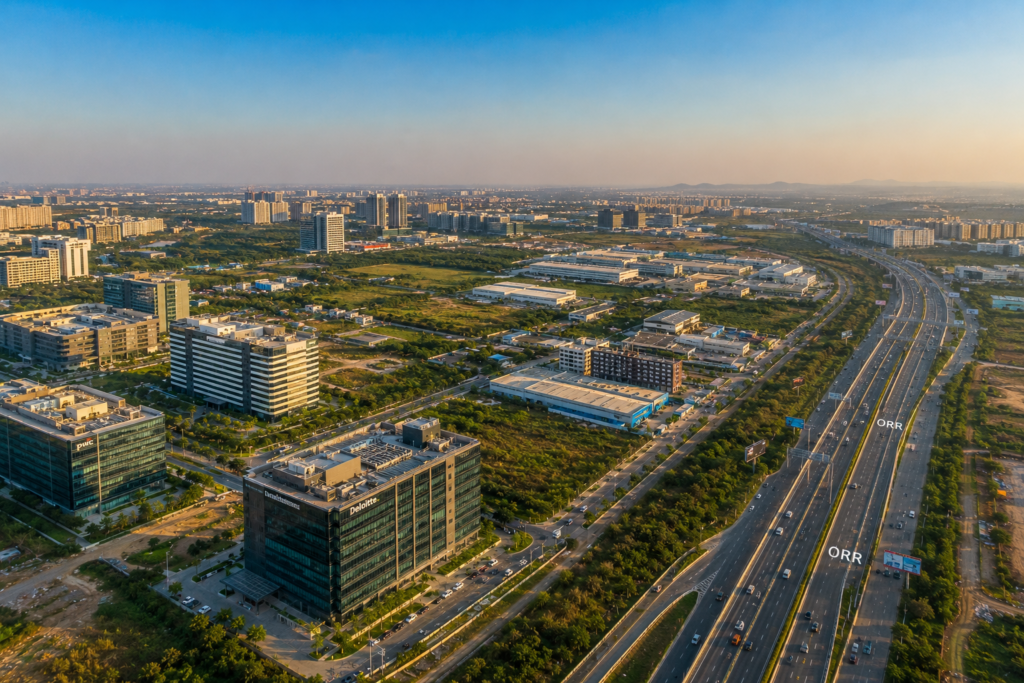
Hyderabad’s IT corridor has evolved from a second-choice destination after Bengaluru into a primary location for Global Capability Centres of multinational firms. Microsoft, Google, Amazon, Apple, Wells Fargo, JP Morgan, Goldman Sachs, Novartis, and hundreds more have built substantial Hyderabad operations. Office absorption has stayed above 10 million sq ft annually for multiple years. Every new GCC adds thousands of jobs in the 12 to 40 lakh salary bracket, which is exactly the profile that drives residential demand.
2. The ORR rewrote the city’s geography
The Outer Ring Road is the single most important piece of infrastructure in Hyderabad’s real estate story. It made the ORR belt genuinely accessible to every major employment node in under 45 minutes, turned what were once village outskirts into high-quality residential corridors, and pulled new master-planned townships into the city’s development path. Kondapur, Tellapur, Kollur, Patancheru, Shamshabad, and the airport corridor all exist as residential markets because of the ORR.
3. Telangana state policy stability
For a sector that rewards predictability, Telangana has delivered steady policy. RERA implementation has been cleaner than in several other Indian states. Land records digitisation under Dharani has reduced title disputes. Approvals through HMDA and GHMC, while not perfect, are more predictable than comparable metros. This stability is invisible when it is working, but it is the reason branded developers keep expanding their Hyderabad pipelines.
4. Pricing discipline relative to peers
Hyderabad apartment pricing has grown consistently, but it has not experienced the overshoots that made Mumbai unaffordable or the correction that Bengaluru saw in certain micro-markets. Rupees-per-square-foot across comparable configurations in Hyderabad remain 20 to 40 percent below Mumbai and 10 to 25 percent below the comparable Bengaluru micro-markets. This pricing gap creates a steady pull of investor and end-user interest from other metros.
5. Integrated township and premium residential supply
Hyderabad’s residential supply has matured from scattered apartment blocks to proper master-planned communities. Integrated townships, gated villa projects, and premium apartment clusters now offer education, healthcare, retail, and recreation inside the campus. This has widened the addressable market: families who would have moved out of Hyderabad to buy standalone villas are now buying within the city in projects like Sansa County.
The metro and infrastructure pipeline ahead
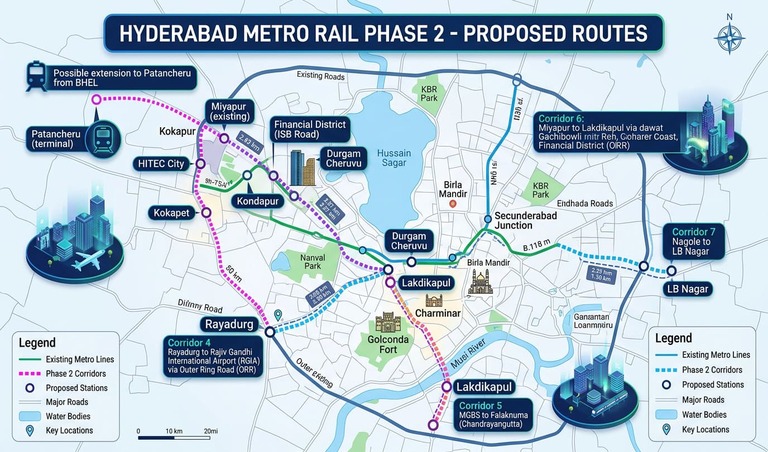
Hyderabad’s growth story is still mid-chapter. The metro is extending into new corridors, Phase 2 of ORR-adjacent infrastructure is being planned, the regional ring road (RRR) is in active development, and multiple new IT clusters are coming up along the airport road. Each of these adds new residential sub-markets before they saturate, which is the mechanism that keeps the appreciation curve smooth rather than spiked.
Where the growth is concentrating now
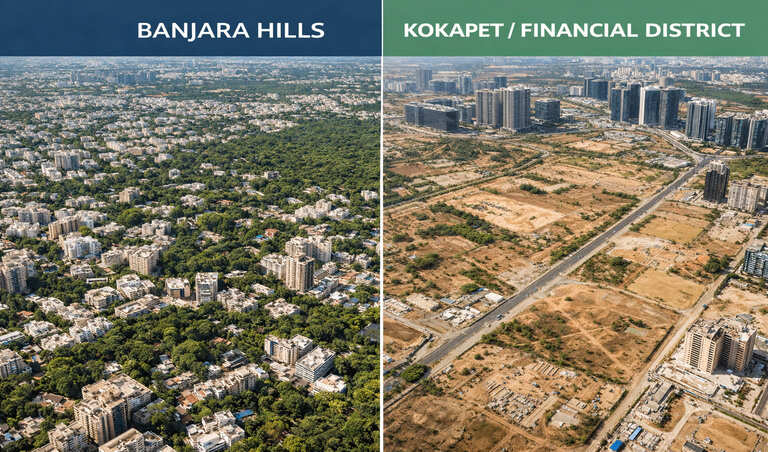
The strongest residential growth in Hyderabad over the next five years is expected in three zones: the western corridor (Kondapur, Tellapur, Kollur, and the Patancheru belt) driven by IT corridor proximity and ORR connectivity, the airport corridor driven by Shamshabad’s expansion, and specific central-business pockets like Financial District and Nanakramguda driven by scarcity of new land. Investors and end-users are increasingly triangulating their picks across these three.
What this means for buyers
Hyderabad real estate is still among the better-risk-adjusted residential markets in India. The growth is structural rather than speculative, the supply is deepening rather than overheating, and the pricing discipline gives buyers real entry points. Projects at The Regent in Kondapur and Sansa County are positioned in exactly the western corridor that these growth dynamics favour.
What are the main reasons behind Hyderabad real estate growth?
Five structural drivers: a deep and still-expanding IT and GCC job engine, the ORR rewriting city geography, Telangana’s relative policy and regulatory stability, pricing discipline relative to Mumbai and Bengaluru, and the maturing supply of integrated townships and premium residential stock.
Is Hyderabad real estate still a good buy in 2025?
Yes, on a risk-adjusted basis. Prices have grown steadily without the overshoots seen in Mumbai or the corrections in specific Bengaluru micro-markets. Office absorption remains in the top three Indian cities, and the infrastructure pipeline (metro extensions, RRR, airport corridor) supports continued demand.
Which Hyderabad corridors will see the strongest growth?
The western corridor (Kondapur, Tellapur, Kollur, Patancheru), the airport corridor (Shamshabad), and specific central-business pockets (Financial District, Nanakramguda). These three concentrations combine infrastructure investment with IT corridor proximity.
How does Hyderabad compare to Bengaluru and Mumbai on pricing?
Hyderabad per-square-foot pricing is typically 20 to 40 percent below Mumbai and 10 to 25 percent below comparable Bengaluru micro-markets for similar configurations. That gap has stayed relatively stable for years and is a key reason investor capital keeps flowing into the city.