
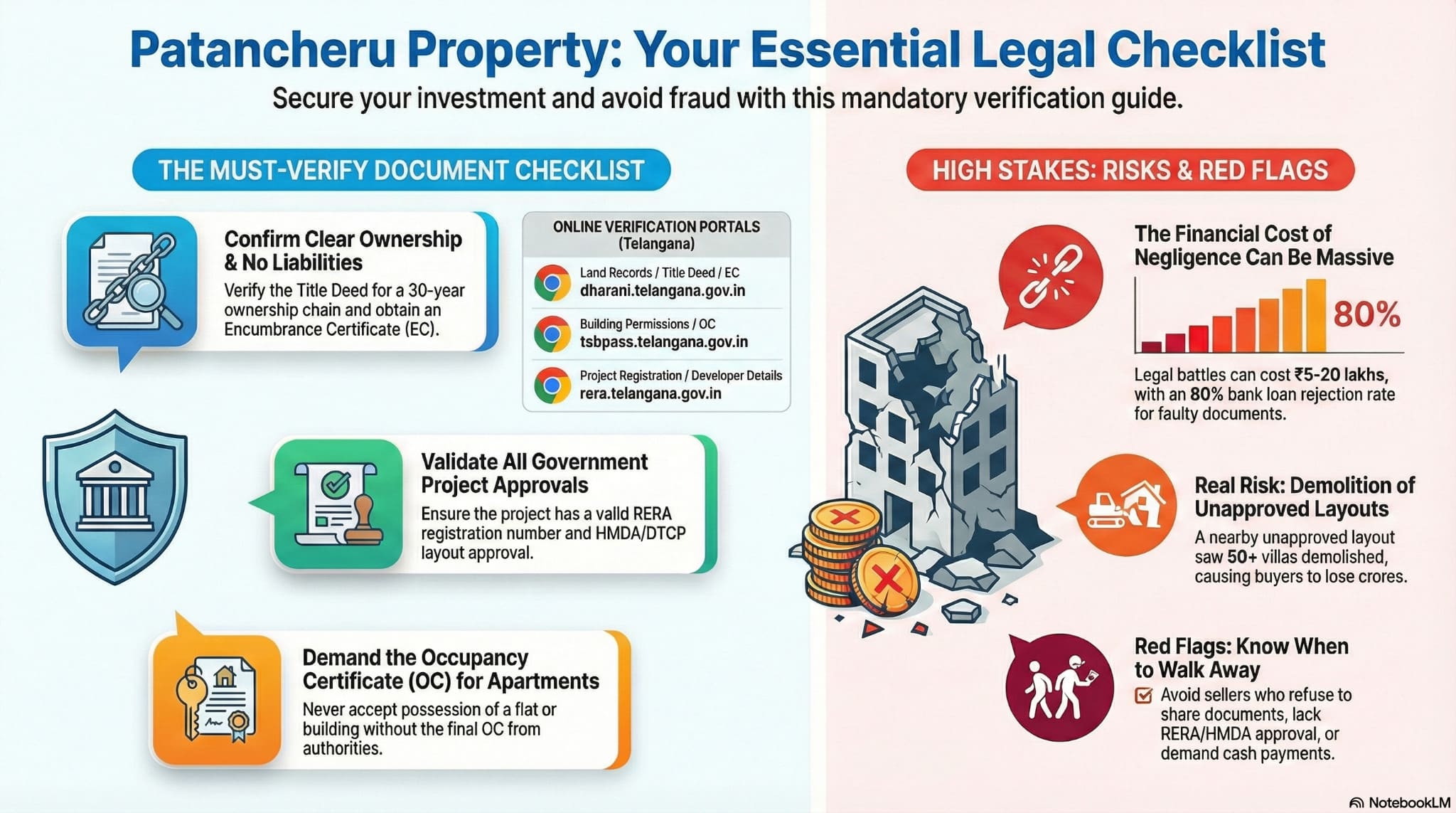
Before buying property in Patancheru, verify these essential legal documents: clear title deed with 30-year ownership chain, Encumbrance Certificate (EC) showing no loans/disputes, valid RERA registration number, HMDA/DTCP layout approval, Occupancy Certificate (OC) for completed projects, sale agreement reviewed by lawyer, and property tax receipts. Use Telangana’s Dharani portal and TS-bPASS for online verification to avoid fraud and disputes.
Buying property represents the largest financial commitment most people make—yet surprisingly, many skip the most critical step: comprehensive legal verification. In Patancheru, a fast-emerging residential hub in West Hyderabad along the Outer Ring Road, the booming real estate market attracts both genuine developers and unscrupulous operators selling disputed land or unapproved layouts. One overlooked document can transform your dream home into a decade-long legal nightmare costing lakhs in litigation. This comprehensive legal checklist walks you through every document and verification step you must complete before investing in Patancheru property.
Why Patancheru Demands Extra Legal Vigilance

Patancheru has emerged as a growing residential destination on Hyderabad’s western edge, offering comparatively more affordable housing options than established hubs such as Gachibowli or Hitec City. Improved road connectivity, proximity to the ORR, and the development of integrated townships have driven this growth.
At the same time, buyers must exercise additional caution due to factors common in peripheral markets—such as agricultural land conversion issues, incomplete ownership records, unauthorised layouts, and overlapping survey numbers. While several established developers are active in the area, thorough legal verification remains essential to ensure a secure and dispute-free property purchase.
The 7 Essential Documents You Must Verify
1. Title Deed — Establishing Clear Ownership
The title deed is the primary document that establishes legal ownership of a property. Buyers should verify a clear and continuous ownership history, typically covering the past two to three decades, and longer in the case of older properties.
Critical checks include:
- An unbroken chain of registered sale deeds covering every transfer of ownership
- Seller’s name matching government-issued identification
- Survey numbers, boundaries, and plot dimensions matching the physical site
- No unexplained gaps that may indicate disputes or irregular transfers
- Proper payment of stamp duty and registration on past deeds
Where to verify: Patancheru’s : From Industrial Hub to Residential Haven
Certified copies can be obtained from the Sub-Registrar Office, and land ownership details may also be accessed through Telangana’s Dharani portal using survey numbers. If you are also interested in exploring leisure options, check out these weekend getaways from Hyderabad.
2. Encumbrance Certificate (EC) — Checking Legal Liabilities
An Encumbrance Certificate reflects all registered financial and legal transactions associated with a property for a selected time period. It helps identify whether the property is free from recorded claims that could affect ownership transfer.
What an EC can reveal:
- Registered home loans or mortgages
- Recorded legal notices or litigation
- Multiple registered sales of the same property
- Development authority charges or acquisition notices
Standard practice:
Buyers typically obtain an EC covering at least the recent decade, with many opting for longer periods to align with the ownership chain being reviewed. ECs can be applied for through official registration services or MeeSeva centres.
Important caution:
A clear EC does not guarantee that a property is dispute-free. Only registered transactions appear on the certificate. Unregistered agreements, recent court cases, or possession-related disputes may not be reflected. Physical site verification and legal review remain essential.
3. RERA Registration — Mandatory Compliance
Under the Real Estate (Regulation and Development) Act, 2016, residential projects exceeding the prescribed area or unit threshold must be registered with the Telangana RERA authority before being marketed or sold.
Why RERA Matters
- Provides legal protection against unreasonable project delays
- Ensures transparent disclosure of approvals, timelines, and project details
- Mandates escrow mechanisms to safeguard buyer funds
- Standardises carpet area definitions to prevent under-delivery
- Offers a formal grievance redressal platform for buyers
- Verification Steps
- Ask the developer for the project’s Telangana RERA registration number
- Visit the official Telangana RERA website
Cross-check:
- Project location and survey details
- Developer and promoter name
- Approved completion timeline
- Status of complaints or regulatory actions
Red flag:
If a project that clearly exceeds RERA thresholds is claimed to be “RERA-exempt,” buyers should treat this as a serious warning sign.
4. HMDA/DTCP Layout Approval — Legal Land Conversion
All residential layouts must receive approval from the appropriate planning authority—HMDA or DTCP—confirming that the land use and layout comply with statutory planning norms.
Essential Documents to Verify
- Official Layout Approval Order with survey numbers and total layout details
- Sanctioned layout plan indicating roads, open spaces, and plot demarcations
- Land use conversion approval, where applicable
- Non-agricultural permission for land originally classified as agricultural
Why This Is Critical
Properties in unapproved layouts face:
- Difficulty or refusal of bank financing
- Limited or denied municipal services
- Legal risks including enforcement actions
- Reduced resale and marketability
How to Verify
- Cross-check approval details on the HMDA / DTCP portal
- Request certified copies ensuring survey numbers match the property exactly
5. Occupancy Certificate (OC) — Permission to Occupy

An Occupancy Certificate confirms that construction has been completed in accordance with approved plans and applicable safety norms.
Why the OC Matters
- Confirms compliance with sanctioned building plans
- Indicates adherence to fire, structural, and safety regulations
- Required by utility providers for permanent water and electricity connections
- Typically required by banks before final loan disbursement
Applicability
- Required for apartments and constructed buildings
- Not applicable to vacant plots where construction is undertaken independently by the buyer
Important note:
Occupying a building without an OC may be treated as unauthorised and can lead to service restrictions or compliance issues later.
6. Municipal Records & Property Tax Receipts
In Telangana, municipal records and property tax receipts serve as proof that a property is recognised by the local civic authority and that taxes are being paid regularly.
What to Verify
- Property owner’s name matches the title deed
- Property tax has been paid consistently in recent years
- Property dimensions and usage align with approved plans
- No outstanding municipal notices or violations
Why This Matters
Properties lacking proper municipal records or with unresolved tax issues may face:
- Difficulty obtaining bank loans
- Challenges in utility connections
- Reduced resale value and buyer confidence
Buyers should obtain the latest property tax receipts and confirm municipal details with the local authority or online civic portals.
7. Sale Agreement — Legal Contract Review
The sale agreement is the primary legal contract governing the transaction. It should always be reviewed by an independent property lawyer before signing.
Key Clauses to Check
- Accurate property description including survey numbers, area, and boundaries
- Total consideration value and detailed payment schedule
- Clearly defined possession and handover timeline
- Seller’s warranties confirming clear title and absence of disputes
- Penalty clauses applicable to both parties in case of default
- Registration timeline and obligations
- References to statutory approvals and compliance (RERA, layout approvals, OC where applicable)
Common Pitfalls to Avoid
- Vague or open-ended possession clauses
- Hidden charges not disclosed upfront
- One-sided penalty clauses favouring the developer or seller
- Missing references to statutory approvals
Legal review costs vary by complexity but are a small expense compared to the risks of an improperly drafted agreement.
Online Verification: Leveraging Digital Tools
Dharani Portal
Use Telangana’s Dharani portal to:
- Access land ownership records
- Verify survey numbers and land classification
- Apply for Encumbrance Certificates
- Cross-check title details against sale documents
TS-bPASS Portal
TS-bPASS helps buyers verify:
- Approved building permissions and plans
- Compliance with planning regulations
- Occupancy Certificate status (where applicable)
- Required departmental approvals and NOCs
Telangana RERA Website
- The Telangana RERA portal allows buyers to:
- Confirm project registration status
- Verify developer credentials
- Review approved timelines and disclosures
- Check complaints or regulatory actions against the project
Step-by-Step Due Diligence Process
Phase 1: Pre-Booking
- Verify RERA registration
- Check HMDA/DTCP approval
- Research developer reputation
- Visit site physically
- Inquire with neighbors
Phase 2: During Booking
- Obtain title deed chain (30+ years)
- Get Encumbrance Certificate (13+ years)
- Hire property lawyer
- Verify on Dharani portal
- Verify municipal recognition and property tax records
Phase 3: Before Registration
- Confirm Occupancy Certificate
- Get fresh EC (within 30 days)
- Final property inspection
- Confirm all dues paid
- Review final sale deed with lawyer
Phase 4: Post-Registration
- Obtain registered deed
- Municipal records and property tax details
- Update tax records
- Apply for utility connections
- Secure all documents safely
Why Reputed Developers Reduce Risk
Established builders significantly lower legal risk through complete statutory compliance, clear title verification, transparent documentation, RERA-mandated escrow accounts, and professional legal teams managing post-possession requirements.
For instance, residential projects in Patancheru by developers like Auro Realty undergo rigorous legal verification before land acquisition, ensuring buyers receive legally compliant properties with clear titles and all statutory approvals in place.
Red Flags: When to Walk Away
Avoid properties showing:
- Developer refuses complete documentation
- Title chain has unexplained gaps
- No HMDA/DTCP approval
- No RERA registration despite project size
- Multiple disputes in EC
- Agricultural land without conversion
- Previous project complaints
- “Too good to be true” pricing (30-40% below market)
- Pressure to sign immediately
- Cash payment demands
Protect Your Investment
Legal verification (typically ₹15,000-30,000 and 30-60 days) is trivial compared to your ₹50 lakh-2 crore investment and potential ₹5-20 lakh litigation costs. Every document verified strengthens your legal position.
Patancheru’s growth makes it attractive with affordable pricing and excellent connectivity via ORR. But smart investors know location and price need legal clarity as the third pillar. Whether exploring flats for sale in Patancheru Hyderabad or villa plots, never compromise on due diligence.
Ready to invest in legally compliant homes? Explore Auro Realty’s residential projects where RERA compliance and transparent documentation come standard.
Related Reading
- Patancheru Real Estate Outlook to 2030
- Property Registration Process in Telangana
- Factors to Check Before Buying Land
- Hidden Art Hubs Near Hyderabad
Frequently Asked Questions
What legal documents should be verified before buying property in Patancheru?
Key documents to verify include the title deed, encumbrance certificate, RERA registration, approved building plan, land use conversion certificate, NOC from relevant authorities, and property tax receipts to ensure clear legal ownership.
Is RERA registration mandatory for properties in Patancheru?
Yes, all residential projects in Patancheru with more than 8 units or plots exceeding 500 sq meters must be registered under RERA Telangana. Buyers should verify the RERA number on the Telangana RERA website before investing.
What are common legal risks when buying land in Patancheru?
Common risks include unclear land titles, encroachment issues, properties in government-restricted zones, absence of proper conversion certificates from agricultural to non-agricultural land, and projects without valid municipal approvals.