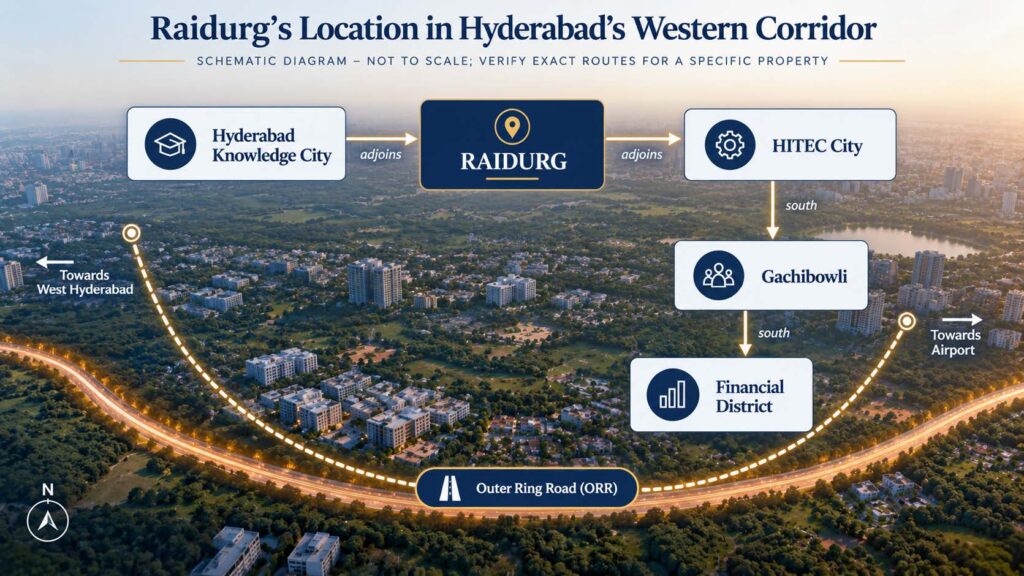
Buying your first apartment is the single largest financial decision most people in their late twenties and thirties will make. And Hyderabad, with its spread of micro-markets from Gachibowli to Kompally, from Financial District to Uppal, makes the decision both exciting and overwhelming. The options are enormous. The price points vary wildly. And the process, if you have never done it before, feels like it was designed to confuse you.
Here is the thing though. The process is not actually complicated. It just has a sequence that most first-time buyers get wrong. They fall in love with a model flat before knowing what they can afford. They sign a booking form without checking RERA. They discover stamp duty and registration costs three weeks before possession and scramble to arrange funds. Every one of these mistakes is avoidable if you follow the right order.
This guide walks you through the five steps of buying your first apartment in Hyderabad, in the exact sequence that protects your money and your peace of mind. Whether you are an IT professional looking at Gachibowli, a young couple exploring Kompally, or a government employee considering LB Nagar, the process is the same. The numbers change. The steps do not.
Step 1: Setting Your Budget and Getting Pre-Approved for a Home Loan in Hyderabad
Most first-time buyers start by browsing apartments online. That is the wrong first step. The right first step is knowing exactly how much apartment you can afford, not how much apartment you want.
How to Calculate Your Real Budget
Your apartment budget is not your salary multiplied by some aspirational number. It is a function of three things: how much down payment you have saved, how much EMI you can comfortably pay each month without compromising your lifestyle, and how much a bank will actually lend you based on your income and existing obligations.
A practical rule: your monthly EMI should not exceed 40% of your take-home salary. If you earn Rs 1 lakh per month after tax, your EMI ceiling is Rs 40,000. At current home loan interest rates of 8.5-9.2% (June 2026), a Rs 40,000 EMI over 20 years supports a loan of approximately Rs 45-48 lakh. Add your down payment (typically 10-20% of property value) and you have your total apartment budget.
Quick Budget Calculator
| Monthly Take-Home | Max EMI (40%) | Approx Budget |
| Rs 60,000 | Rs 24,000 | Rs 35-42 lakh |
| Rs 80,000 | Rs 32,000 | Rs 45-55 lakh |
| Rs 1,00,000 | Rs 40,000 | Rs 55-68 lakh |
| Rs 1,50,000 | Rs 60,000 | Rs 80 lakh – 1 Cr |
| Rs 2,00,000 | Rs 80,000 | Rs 1-1.3 Cr |
Note: Budget assumes 15-20% down payment added to loan amount. Actual eligibility varies by bank, credit score, and existing liabilities.
Why Pre-Approval Matters More Than You Think
A home loan pre-approval is a written confirmation from a bank that they will lend you a specific amount based on your income documents and credit history. It is not a final sanction. It is a conditional approval that typically stays valid for 3-6 months.
Getting pre-approved before you start looking at apartments does three things. First, it eliminates the uncertainty of whether you can actually afford the flat you like. Second, it gives you credibility with builders and sellers, because a pre-approved buyer is a serious buyer. Third, it surfaces any credit issues early, like a forgotten credit card default from 2019 that tanked your CIBIL score, giving you time to fix them before you find your dream apartment.
In Hyderabad, SBI, HDFC, ICICI, and Axis Bank are the most active home loan lenders. Pre-approval typically takes 5-7 working days and requires your last 6 months of salary slips, 2 years of ITR, bank statements, and a CIBIL score of 700 or above for the best rates.
The Hidden Costs Nobody Tells First-Time Buyers About
Your apartment cost is not just the base price. In Telangana, stamp duty is 6% of the property value. Registration charges are 0.5%. GST is 5% on under-construction properties (1% for affordable housing below Rs 45 lakh). Maintenance deposits typically range from Rs 50,000-2 lakh. Legal and documentation fees add Rs 10,000-25,000. And if you are buying a semi-furnished unit, interior fit-out costs Rs 5-15 lakh depending on the size and your taste.
On a Rs 60 lakh apartment, the additional costs add up to approximately Rs 7-10 lakh. That is money you need available in cash or savings, not through your home loan. Budget for it from day one, or you will be caught short at the worst possible moment.
Step 2: Shortlisting the Right Locality Based on Lifestyle and Work Location

Hyderabad is a geographically spread city. The difference between choosing Gachibowli and choosing Uppal is not just Rs 2,000 per sq ft. It is the difference between a 15-minute commute and an 80-minute commute. It is the difference between walkable restaurants and ordering everything online. This step is where most first-time buyers either get it right or regret their decision for the next 15 years.
The Commute-First Framework
Your workplace determines your locality shortlist. Not your parents’ suggestions. Not your friend who bought in Bachupally. Not the Instagram ad that showed a swimming pool in Shamshabad. Your office. Specifically, the commute from your apartment to your office on a regular Tuesday at 9 AM, not on a Sunday afternoon when the roads are empty.
A practical rule: keep your one-way commute under 45 minutes in normal traffic. For IT professionals working in HITEC City or Gachibowli, that means Kondapur, Manikonda, Narsingi, Kokapet, or Tellapur. For those in the financial district, add Nanakramguda, Puppalaguda, and parts of Gandipet. For pharma and manufacturing professionals in Medchal or Patancheru, Kompally, Miyapur, and Bachupally make more sense.
What to Look for During a Locality Visit
Never buy an apartment based on the builder’s location map or a Google Maps screenshot. Visit the locality on a weekday morning and a weekend evening. Walk the 500-metre radius around the project. Check if there is a functional grocery store, a pharmacy, and a hospital within 3 km. Look at the road quality leading to the project. Ask auto drivers about the area’s flooding history during monsoons. Check the mobile network strength inside the building. These things do not show up in a brochure, but they determine whether you enjoy living there or merely tolerate it.
Talk to people who already live in the area. Walk into a nearby apartment complex and ask a security guard how long power cuts last. Ask a shopkeeper whether the roads flood in October. These 30-minute conversations will tell you more about a locality than every property portal review combined.
Step 3: Verifying RERA Registration, Legal Title and Builder Track Record
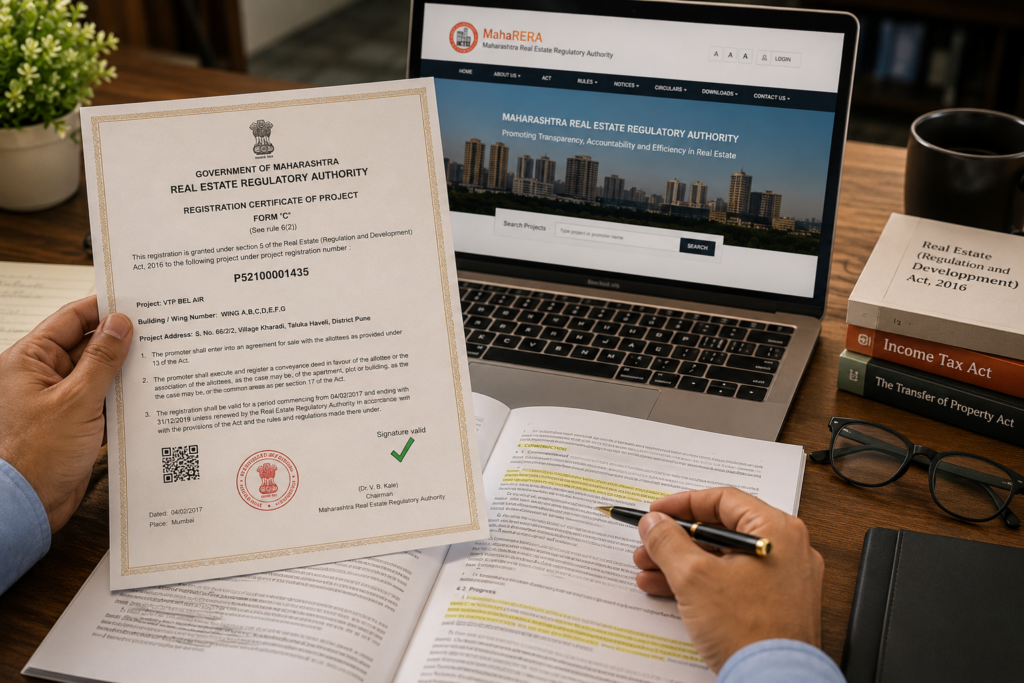
This is the step that protects you from losing your money. Everything else in this guide is about getting the best value. This step is about not getting cheated. Skip it at your own risk.
Checking RERA Registration
Every residential project in Telangana with more than 8 apartments or a plot area exceeding 500 sq metres must be registered with the Telangana Real Estate Regulatory Authority (TS-RERA). The RERA number is your first filter. If a project does not have one, walk away. No exceptions.
To verify, go to rera.telangana.gov.in and search for the project by name, promoter name, or RERA registration number. The portal shows the approved layout plan, the number of sanctioned units, the completion timeline, and whether the project has any compliance issues. If the RERA certificate shows a different project area or unit count than what the builder is marketing, that is a red flag.
What RERA registration gives you: legal recourse if the builder delays possession beyond the promised date, protection against changes to the approved layout without your consent, a defined process for complaints and refunds, and a builder who has submitted their project financials to the authority.
Verifying the Legal Title
The land on which the apartment is built must have a clear title, meaning the builder or landowner has legitimate, undisputed ownership. In Hyderabad, land disputes are not rare. Encroachment, litigation, and unclear succession are real risks, especially on the city’s expanding periphery.
Hire an independent property lawyer. Not the builder’s lawyer. Your own lawyer. It should cost Rs 5,000-15,000 for a title search, which includes checking the chain of ownership documents going back 30 years, confirming that the land is not under litigation, verifying that the necessary approvals from HMDA or GHMC are in place, and ensuring that the conversion from agricultural to residential use (if applicable) has been completed.
Key documents to request from the builder: title deed, encumbrance certificate (EC) for the last 30 years, approved building plan from HMDA/GHMC, commencement certificate, RERA registration certificate, and the landowner agreement (if the project is a joint development with a landowner). If the builder hesitates to share any of these, find another builder.
Evaluating the Builder’s Track Record
A RERA registration protects you legally. A good builder protects you practically. The distinction matters. RERA cannot force a builder to use quality cement or install reliable elevators. That comes from the builder’s reputation and track record.
Research the builder’s previous projects. Visit one of their completed buildings that is 3-5 years old. Look at the exterior paint condition, the lobby maintenance, the lift reliability, the water supply consistency, and the community feel. Talk to residents. Ask them the one question that reveals everything: would you buy from this builder again? If most say yes, the builder is likely competent. If you hear hesitation, complaints about maintenance handover, or stories about promised amenities that never materialised, keep looking.
In Hyderabad, established developers with a track record of 5+ completed projects and on-time delivery include names you will recognise. Newer developers are not automatically bad, but they carry more risk. If you choose a newer developer, verify that their project financing is from a nationalised bank (SBI, PNB, Bank of Baroda) rather than private NBFCs, which signals stronger financial due diligence.
Step 4: Understanding Payment Plans, Stamp Duty and Registration Process
You have found your apartment. You have verified RERA and the builder. Now comes the part where money actually changes hands, and where first-time buyers most often make expensive mistakes.
Types of Payment Plans
Builders in Hyderabad typically offer three payment structures. Understanding which one to choose can save you lakhs in interest costs.
Construction-Linked Plan (CLP)
You pay in instalments linked to construction milestones: 10% at booking, 10% at foundation, 15% at first floor, 15% at mid-structure, and so on until possession. Your home loan disburses in stages, so you pay interest only on the amount disbursed (called pre-EMI interest). This is the safest option for under-construction properties because your payments are tied to actual progress.
Down Payment Plan
You pay 70-80% of the property value upfront within 30-90 days and the balance at possession. Builders offer 3-7% discounts on this plan. It works if you have significant cash or are selling another property. The risk is that your money is fully committed while the building is still under construction.
Possession-Linked Plan
You pay 10-20% at booking and the rest at possession. This sounds ideal but is rare. Builders charge a premium (usually 5-10% above CLP pricing) because they bear the construction financing cost. If offered, read the fine print carefully.
Stamp Duty and Registration in Telangana (2026)
| Component | Rate | On Rs 60 L Flat |
| Stamp Duty | 6% of property value | Rs 3,60,000 |
| Registration Charges | 0.5% of property value | Rs 30,000 |
| Transfer Duty | 1.5% (if applicable) | Rs 90,000 |
| GST (under-construction only) | 5% (excl. land) | Rs 1,80,000* |
| Legal & Documentation | Flat fee | Rs 15,000-25,000 |
| Total Additional Costs | Rs 6.75-8.85 L |
*GST applies only to under-construction properties. Ready-to-move apartments with OC are GST-exempt. Affordable housing (below Rs 45 lakh) attracts only 1% GST.
The Registration Process Step by Step
Registration happens at the Sub-Registrar’s Office (SRO) under the jurisdiction where the property is located. In Telangana, the process has been digitised significantly, but you still need to appear in person.
1. Pay stamp duty online through the TS-IGRS portal (registration.telangana.gov.in). You will receive a challan.
2. Book a slot at the relevant SRO through the same portal. Slots fill quickly, so book 7-10 days in advance.
3. Prepare the sale deed document. Your builder or lawyer will draft this. Review it carefully for property details, payment terms, and possession conditions.
4. Visit the SRO on your appointed date with the buyer(s), two witnesses, the original sale deed, stamp duty challan, ID proofs (Aadhaar + PAN), and passport-sized photographs.
5. The registrar verifies documents, captures biometrics, and registers the deed. You receive a registered sale deed within 3-5 working days.
After registration, apply for mutation of the property in municipal records (GHMC or relevant local body). This updates the ownership in the property tax records and is essential for future resale or loan purposes.
Step 5: Final Inspection, Possession and Key Handover Checklist for First-Time Buyers
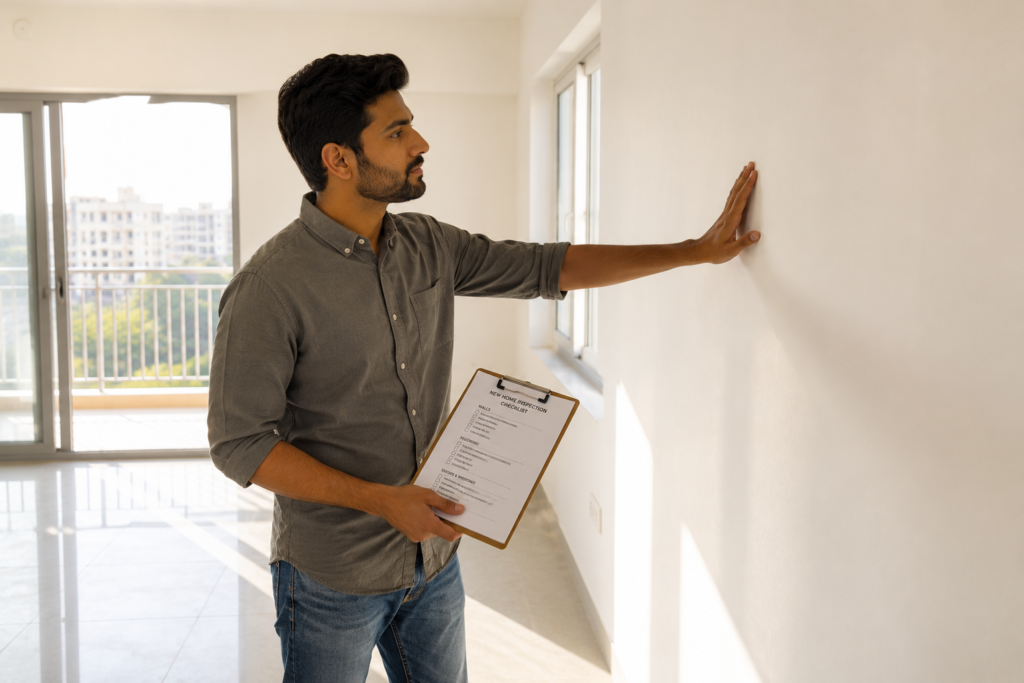
The builder has sent the possession letter. You are excited. You want the keys immediately. Slow down. The final inspection is the last chance you have to ensure that the apartment you paid for is the apartment you received. After you sign the possession receipt, your leverage to get defects fixed drops dramatically.
The Pre-Possession Inspection
Visit the apartment with a checklist and, if your budget allows, a professional inspection service (Rs 3,000-8,000 in Hyderabad). Do not rely on a quick walkthrough. Spend at least 90 minutes in the unit. Go room by room.
Structural and Finishing Checks
• Walls: Check for cracks, unevenness, and paint finishing. Run your hand along the surface. Look for damp patches, especially near windows and in bathrooms.
• Flooring: Walk every tile. Listen for hollow sounds, which indicate improper adhesion. Check for level using a spirit level or a marble test (a marble should not roll on a properly levelled floor).
• Doors: Open and close every door. They should move freely without scraping the floor. Check locks, handles, and hinges. Door frames should be flush with walls.
• Windows: Open, close, and lock every window. Check the seal by holding a piece of tissue near the edges on a windy day. Water seepage through window frames is one of the most common post-possession complaints.
Plumbing and Electrical
• Turn on every tap and flush every toilet simultaneously. Check water pressure and drainage speed. Look under sinks for leaks.
• Test every electrical switch, socket, and light point. Carry a phone charger and test at least 3-4 sockets per room.
• Check the geyser points in bathrooms and kitchen. Ensure the exhaust fans are functional.
• Verify the electrical panel. Each circuit should be labelled (bedroom 1, kitchen, AC, etc.). Check the MCB and ELCB are functioning.
Common Areas
• Inspect the lift operation. Ride it from the ground floor to your floor and back. Check for unusual sounds or jerky movement.
• Walk through the parking area and locate your designated spots. Check for adequate lighting and ventilation.
• Verify that amenities shown in the brochure actually exist and are functional: gym equipment, pool filtration, generator capacity, fire safety systems.
The Snag List
Document every defect you find in writing. This is called a snag list. Include photographs with timestamps. Submit it to the builder’s site office with a formal letter (keep a signed copy). Reputable builders address snag-list items within 15-30 days. Do not sign the possession receipt until critical items are resolved.
Minor cosmetic issues (a paint touch-up, a loose handle) can be noted for post-possession fixing. But structural issues (wall cracks, plumbing leaks, electrical faults) must be fixed before you take possession. Once you sign, the builder’s motivation to fix things drops to near zero.
Documents You Must Collect at Handover
• Registered sale deed (original)
• Occupancy Certificate (OC) or Completion Certificate (CC) from HMDA/GHMC
• RERA compliance certificate
• Approved building plan and layout
• NOC from the fire department
• NOC from the pollution control board (for larger projects)
• Allotment letter and all payment receipts
• Share certificate of the land (for joint development projects)
• Warranty cards for appliances, lifts, and DG sets
• Maintenance agreement and society formation details
Store all these documents in a waterproof, fireproof folder and keep digital scans. You will need them for property tax mutation, society registration, future resale, and home loan closure.
Frequently Asked Questions
Q1: What is the minimum salary required to buy a flat in Hyderabad?
There is no fixed minimum salary, but as a practical benchmark, a monthly take-home of Rs 50,000-60,000 can support a home loan EMI for apartments in the Rs 35-45 lakh range in localities like Kompally, Miyapur, or LB Nagar. Banks typically approve loans where EMI does not exceed 40-50% of net monthly income. A CIBIL score above 700 is essential for competitive interest rates.
Q2: How much down payment do I need for a first apartment in Hyderabad?
Banks finance 75-90% of the property value. You need 10-25% as down payment plus 8-12% for stamp duty, registration, GST, and other costs. For a Rs 60 lakh apartment, plan for Rs 6-15 lakh as down payment and Rs 6.75-8.85 lakh in additional charges. Total cash required before moving in: approximately Rs 13-24 lakh.
Q3: What are the stamp duty and registration charges in Hyderabad in 2026?
Stamp duty in Telangana is 6% of the property value. Registration charges are 0.5%. Transfer duty of 1.5% may apply in certain transactions. On a Rs 60 lakh apartment, stamp duty is Rs 3.6 lakh and registration is Rs 30,000. These must be paid before the sale deed is registered at the Sub-Registrar Office.
Q4: How do I check if a project is RERA registered in Hyderabad?
Visit the Telangana RERA portal at rera.telangana.gov.in. Search by project name, promoter name, or RERA registration number. The portal shows the approved layout, unit count, project timeline, and compliance status. Never book or pay for a project that is not RERA registered, as you have no legal protection without it.
Q5: Which localities in Hyderabad are best for first-time home buyers in 2026?
For IT professionals, Kondapur, Narsingi, and Tellapur offer the best commute-to-value ratio. For budget-conscious buyers, Kompally, Miyapur, and Bachupally have apartments under Rs 50 lakh with growing infrastructure. For east Hyderabad, LB Nagar and Uppal provide metro access and established neighbourhoods. Your workplace commute should be the primary decision driver.
Q6: Should I buy an under-construction or ready-to-move apartment?
Under-construction apartments are 10-20% cheaper and attract 5% GST but carry completion risk and require pre-EMI interest payments during construction. Ready-to-move apartments are GST-exempt, let you see the actual unit, and allow immediate occupation. First-time buyers with lower risk tolerance should prefer ready-to-move or near-completion projects from established builders.
Q7: What documents should I check before buying a flat in Hyderabad?
Essential documents include the title deed, encumbrance certificate for 30 years, RERA registration, approved building plan from HMDA or GHMC, commencement certificate, landowner agreement (for joint development projects), and occupancy certificate (for ready-to-move properties). Hire an independent lawyer for Rs 5,000-15,000 to verify these. Never rely solely on the builder’s assurance.
Q8: Can I claim tax benefits on my first home purchase in Hyderabad?
Yes. Under Section 80C, you can claim up to Rs 1.5 lakh per year on principal repayment. Under Section 24(b), you can claim up to Rs 2 lakh per year on home loan interest for a self-occupied property. First-time buyers also get an additional Rs 50,000 deduction under Section 80EEA if the property value is below Rs 45 lakh. These benefits apply to all salaried and self-employed individuals.