South India has been quietly winning the residential race. Over the last five reporting cycles, Hyderabad, Bengaluru and Chennai have together accounted for roughly half of all new-home launches and sales in the country — and the share has been trending up, not down. If you are reading demand signals across India right now, the most interesting ones are in the south. This is why, and what it means for buyers sitting on the fence.
Rapidly Developing Infrastructure
Infrastructure is the single biggest reason southern residential corridors keep compounding. Hyderabad’s Outer Ring Road and expanding Metro, Bengaluru’s Peripheral Ring Road and suburban rail, Chennai’s third Metro phase and the Coimbatore–Madurai expressway network have all pushed commute radii outward. Homes that were 90 minutes from the office in 2018 are now 45 minutes, and that one change resets pricing for entire belts.
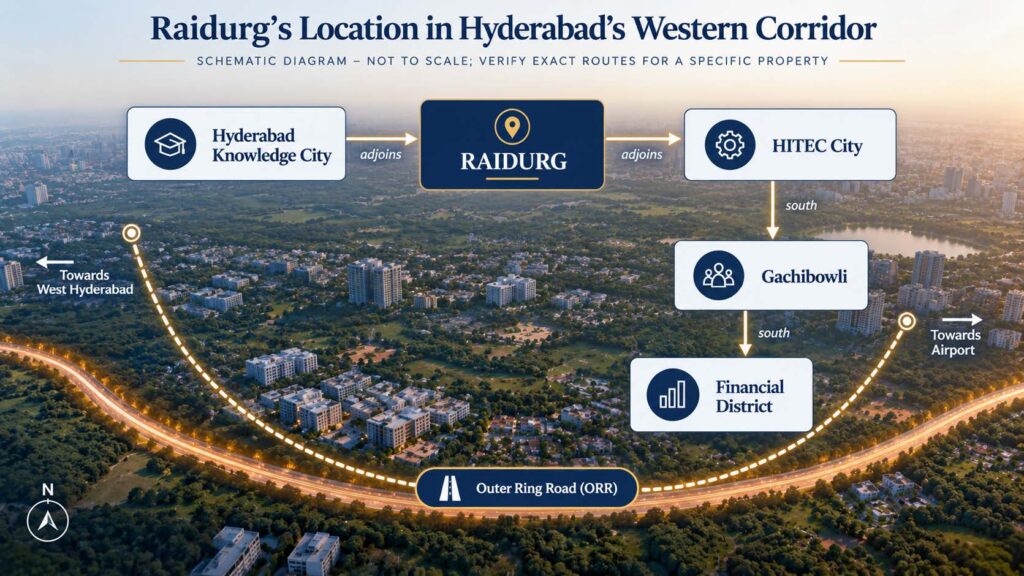
The second-order effect is arguably bigger: schools, hospitals and retail follow infrastructure by 18–24 months, social infrastructure lifts resale values, and the market reprices again. Hyderabad’s Financial District, Gachibowli and Kokapet belt is the clearest case study — infrastructure first, office next, lifestyle third, appreciation last. For the fuller picture, our Hyderabad real estate growth breakdown covers the specific drivers.
What buyers should actually check
Before you commit to a project because “the Metro is coming”, verify three things: the route has been formally sanctioned (not just announced), construction has started on at least one adjacent segment, and the nearest station is within a genuine 10-minute walk. Rail infrastructure is repriced into property the moment it opens, not when it is announced.
Growth of IT Sectors and Corporate Demand
IT absorption in the southern trio dwarfs every other region in India. Hyderabad crossed a record office leasing year in the last reporting cycle with more than 10 million sq ft absorbed, Bengaluru maintained its historical lead, and Chennai’s OMR and Pallavaram belts added significant Global Capability Centre (GCC) capacity. Corporate leasing translates almost directly into residential demand — the 1:1.5 thumb rule (every 1 million sq ft of office absorption creates roughly 1.5 million sq ft of home demand within a 10-km radius) has held up across all three cities.
For buyers, this is the cleanest signal to follow: pick a corridor where a named office tenant has signed a long lease in the last 12 months. That one data point filters out most speculative projects and keeps you anchored to where people will actually want to live. Gachibowli and Financial District in Hyderabad, ORR-East in Bengaluru, and OMR Phase II in Chennai are the current standouts.
Foreign and NRI Investors
NRI and foreign buyer interest in South India has been steady because of three factors: transparent registration systems (Telangana’s Dharani portal is a particular favourite for NRI buyers), a clear RERA track record compared with some northern markets, and pricing that still delivers genuine value in dollar terms. The Middle East, Singapore and US corridors contribute the bulk of the NRI flow, with the southern cities getting a disproportionate share.
This is why the luxury and premium segments in Hyderabad and Bengaluru keep absorbing supply even when the mass market wobbles. NRI capital is sticky and long-dated. For a walkthrough of what NRI buyers in India should specifically watch for — FEMA limits, repatriation rules, and tax withholding — our NRI home-buying checklist is a useful companion read.
Affordability, Supply Discipline and Inventory Health
South India’s quiet advantage over the NCR and MMR markets is supply discipline. Unsold inventory in Hyderabad and Bengaluru has stayed in a healthier range (roughly 18–26 months of forward sales, against 35+ months in some northern cities) because developers here launch more conservatively and deliveries are on time more often. Add the pricing advantage — even luxury apartments in Gachibowli trade meaningfully below comparable Mumbai and Delhi micro-markets — and the case for a southern apartment over a northern one is straightforward on total returns.
Our buyer-side view is pragmatic: within each southern city, concentrate on the inner-corridor, office-linked belt, check the developer’s delivered track record, and ignore projects in speculative outlying belts unless there is a named infrastructure catalyst with a funded timeline. Dig deeper into Gachibowli and new apartment supply in Hyderabad for project-level evaluation.
Frequently Asked Questions
Why is South India leading India’s residential market?
Three structural reasons: consistent IT and GCC office absorption that keeps housing demand anchored, disciplined supply with healthier inventory levels than northern markets, and strong infrastructure investment (Metro, ORR, expressways) that keeps resetting commute economics in favour of the southern corridors.
Which southern city offers the best residential returns?
Hyderabad currently offers the cleanest mix of affordability, supply discipline and infrastructure momentum, particularly in the Gachibowli–Financial District belt. Bengaluru’s ORR-East and Chennai’s OMR are strong alternatives depending on buyer preference and corporate anchor.
Are NRIs a major part of the South India market?
Yes, NRI inflows have been a steady contributor to luxury and premium absorption in Hyderabad and Bengaluru, helped by transparent registration systems like Telangana’s Dharani portal and a cleaner RERA record than some other markets.
What should buyers prioritise when picking a southern city property?
Three things: the corridor has a confirmed office catalyst within 15 minutes, the developer has delivered at least two past projects on time, and pricing is within 10–15 percent of the corridor median. Projects in outlying belts without a named infrastructure anchor should be avoided.
How does South India’s inventory health compare nationally?
Unsold inventory in Hyderabad and Bengaluru typically runs in the 18–26 months of forward sales range, meaningfully healthier than parts of NCR and MMR where the figure can exceed 35 months. This disciplined supply is a big part of why southern prices have held up.