Hyderabad has more real estate brands today than at any point in the city’s history. RERA has cleaned up the field, but it has not removed the burden on buyers to evaluate developers properly. A home is the largest single purchase most families will make, and the difference between the right developer and the wrong one shows up in possession dates, build quality, resale value, and how much sleep you lose along the way.
This is the checklist a serious buyer should run before signing any agreement in Hyderabad.
1. RERA registration is non-negotiable
Verify the project’s RERA number on the Telangana RERA portal directly. Do not rely on the brochure. The portal will tell you the registered project area, the promoter’s track record, the number of complaints filed, and the original delivery commitment. If a project is not RERA-registered, walk away. There is no acceptable reason in 2025.
2. Track record of completed projects, not announcements
A developer’s pipeline of upcoming projects tells you very little. What matters is what they have actually delivered. Ask for a list of completed projects, drive through two or three of them on a weekday afternoon, and look at the maintenance, the lobby finishes, the lift quality, and the resident sentiment. A developer who has handed over five strong projects is safer than one with twenty announcements.
3. On-time delivery history
Delays are the single largest hidden cost of buying under construction. Pull the original committed completion date from old RERA filings or news coverage and compare it against the actual handover date. A developer who is consistently within six months of commitment is rare and worth paying a premium for. One who has delayed past projects by two or three years is a risk no buyer should normalise.
4. Construction quality you can verify
Brochures show finishes; only the structure tells the truth. If the project is under construction, request a site visit during the structural stage and check the steel grade, the concrete cover, the wall plumb, and the slab thickness. If the project is ready, look at the joinery, the tile alignment, and the plumbing fixtures. Tap on internal walls to check whether they are solid block or hollow partition. The article on construction quality checks goes deeper into what to look for.
5. Land title and approvals
Even with RERA, title due diligence remains the buyer’s responsibility. The developer should be able to share clear documents covering land ownership, conversion of agricultural land where relevant, HMDA or GHMC approvals, environmental clearance for projects above five acres, and a no-encumbrance certificate for the past thirteen years. Hire an independent property lawyer for one or two days, not the developer’s lawyer. The fee is small relative to what you are protecting.
6. Financial health and bank approvals
If a project is approved by the major banks for home loans, that is a strong signal. The bank’s legal and technical team has already vetted title, approvals, and developer reputation before extending project-level approval. Conversely, if no scheduled bank will fund a particular project, treat it as a serious red flag and ask why.
7. Transparency in pricing and payment schedule
The all-inclusive price should be on paper before token: base rate, floor rise, PLC, parking, club membership, electrical and water connection charges, GST, registration, and corpus. A developer who keeps adding line items as the booking progresses is one to avoid. The construction-linked payment schedule should match physical milestones, not arbitrary months on a calendar.
8. Post-handover service and maintenance
What happens in year three is more revealing than what happens in year one. Visit two of the developer’s older projects and talk to residents. Ask how snags were handled, whether the developer ran maintenance fairly during the transition to the resident association, and what the corpus situation looks like now. The way a developer behaves after handover is the truest measure of their brand.
9. Location intelligence
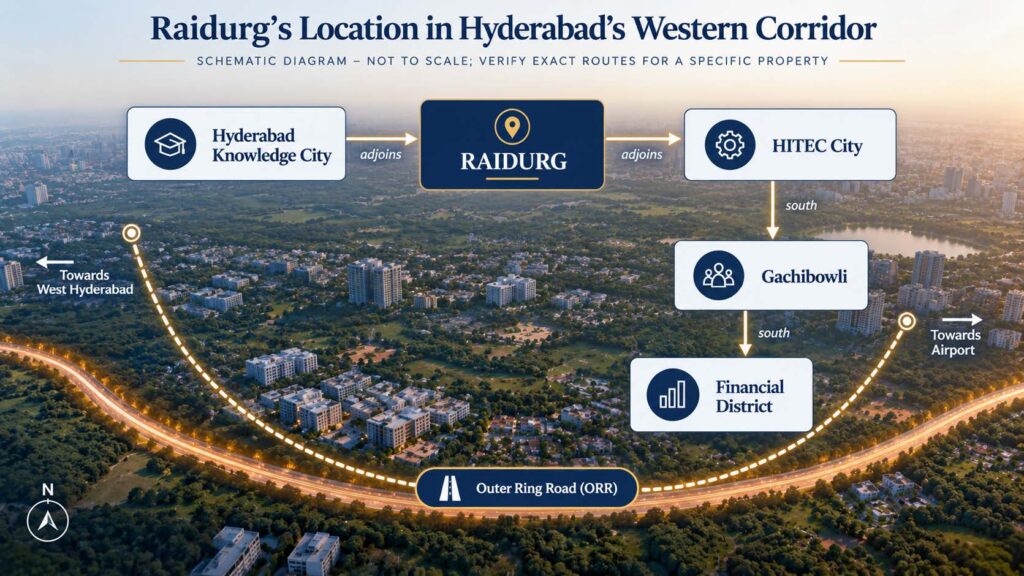
The right developer in the wrong micro-market still leaves you with a weak asset. Cross-check the project location against the city’s strongest residential corridors. The pieces on coveted localities for investment and Kondapur as an investment market are useful starting points for Hyderabad-specific context.
10. Brand consistency, not brand noise
Marketing budgets do not build buildings. Look for developers whose visible communication matches what previous buyers report. Walk away from anyone whose sales team makes verbal promises that are not in writing. The best Hyderabad developers are quietly consistent across projects: similar finish standards, similar approval processes, similar handover timelines.
How Auro Realty fits this checklist
Auro Realty has built across Hyderabad with RERA-registered projects, bank-approved financing, and a delivery record that residents can independently verify. The Regent in Kondapur, Sansa County integrated township, and the wider portfolio give buyers a working example of what these ten checks look like when a developer takes them seriously.
How do I verify a real estate developer in Hyderabad?
Start with the Telangana RERA portal to confirm registration, then verify HMDA or GHMC approvals, check the title chain through an independent property lawyer, and visit two or three completed projects to assess delivery quality and resident sentiment.
What documents should a developer share before booking?
At minimum: RERA registration certificate, land title documents, HMDA or GHMC approval, environmental clearance for projects above five acres, encumbrance certificate, the all-inclusive price sheet, and the construction-linked payment schedule tied to physical milestones.
Why is bank approval an important signal?
When major banks approve a project for home loans, their legal and technical teams have already vetted the title, approvals, and developer reputation. A project that no scheduled bank will fund deserves serious scrutiny.
What is the safest way to check construction quality before booking?
Visit during the structural stage if the project is under construction. Inspect steel grade, concrete cover, wall plumb, and slab thickness. For ready projects, check joinery, tile alignment, plumbing fixtures, and tap walls to confirm solid block construction rather than hollow partitions.