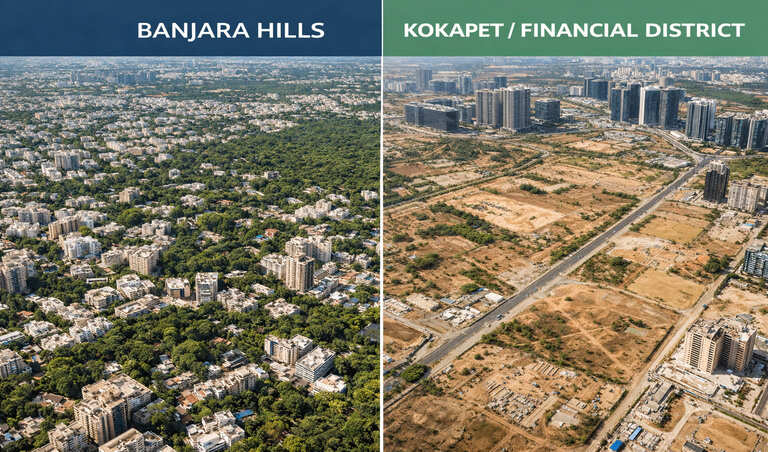
Getting a home loan in India used to feel like a negotiation. Today it is a documentation exercise, banks run most of the decision on eligibility data and credit history, and the borrower who shows up prepared gets better rates and faster disbursement. This home loan checklist walks through what you actually need, what will get questioned, and where buyers commonly get tripped up.
Whether you are buying your first apartment in Hyderabad, upgrading from a rented flat, or investing in a second home, the same checklist works. Do it in the right order and you move from application to sanction in two to three weeks. Skip items and it stretches to two months.
The Complete Home Loan Checklist
Before you formally apply, work through these four areas. Every major bank, SBI, HDFC, ICICI, Axis, LIC Housing Finance, PNB Housing, and Kotak, asks the same set of questions. The paperwork they need is more or less identical.
1. Understand If You Are Eligible
Eligibility is the first filter. Banks evaluate three things: your income, your credit score, and your existing obligations.
Age and employment: Most banks lend to salaried applicants between 21 and 65, and self-employed applicants between 25 and 70 at the end of the loan tenure. A 40-year-old with a 20-year tenure is fine. A 55-year-old wanting the same 20-year tenure will get pushed to 10 or 12 years.
Credit score (CIBIL): 750 and above gets the best rates. Between 700 and 749 you will be sanctioned but at a slightly higher interest rate. Below 700, expect questions or rejection. Check your CIBIL report before applying, disputed entries or closed cards sometimes show as active and drag your score down.
Income multiple: Salaried borrowers are typically approved for 4 to 5 times annual income. Self-employed get 3 to 4 times declared annual income, averaged across two or three years of ITR.
FOIR (Fixed Obligation to Income Ratio): Your total EMIs across all loans and credit card minimums should stay under 50 percent of net monthly income. If you already have a car loan plus credit card EMIs, that reduces how much home loan the bank will offer.
2. Know the Real Costs of a Home Loan
The interest rate is the number most borrowers fixate on, but it is not the only cost. Expect the following when you take a home loan in India in 2026.
Processing fee: 0.25 percent to 1 percent of the loan amount, capped at around INR 10,000 to 25,000 depending on the lender. Often negotiable if you push.
Legal and technical fees: INR 5,000 to 15,000 combined. Covers the bank’s legal opinion on your property documents and their independent valuation of the property.
Stamp duty on loan agreement: Varies by state. Telangana currently charges 0.5 percent on the loan amount as stamp duty, capped at INR 50,000.
Property insurance: Most banks require a one-time home insurance policy covering fire, earthquake, and structural damage. Costs INR 8,000 to 20,000 depending on the loan amount.
Pre-EMI interest: For under-construction properties, you pay interest on the disbursed portion during the construction period before your full EMI kicks in. Calculate this into your monthly outgo planning.
Prepayment charges: On floating-rate loans, there are no prepayment charges under current RBI rules. On fixed-rate loans, most banks charge 2 to 4 percent of the prepaid amount.
3. Documents Required for a Home Loan
The document list does not vary much between banks. Get all of these ready before you apply and you will save yourself a week of back-and-forth.
Identity and address proof: PAN card (mandatory), Aadhaar, passport, voter ID, or driving licence. Recent utility bill or rental agreement for address verification.
Income proof for salaried applicants: Last three months’ salary slips, last two years’ Form 16, last six months’ bank statements from the salary account, and a letter from your employer confirming your role and tenure.
Income proof for self-employed: Last three years’ ITR with computation of income, last three years’ audited balance sheet and profit and loss statement, last six months’ current account statements, GST returns for the last year, and proof of business address.
Property documents: Sale agreement or allotment letter, approved building plan, occupancy certificate (for ready-to-move-in), RERA registration (for under-construction), encumbrance certificate for the last 13 to 30 years, and receipts of any advance payments already made to the seller or builder.
Existing loan statements: If you have any active loans or credit cards, bring the latest statement. The bank will check closure dates on closed loans too.
4. Use the Tax Benefits Available on a Home Loan
A home loan comes with three distinct income tax benefits in India. Most borrowers know about two and miss the third.
Section 24(b), interest deduction: Up to INR 2 lakh per year on interest paid, for a self-occupied property. For a let-out property, the full interest is deductible against rental income (with some restrictions).
Section 80C, principal deduction: Up to INR 1.5 lakh per year on principal repayment, within the overall 80C limit (which includes PPF, ELSS, life insurance premiums, and a few other instruments).
Section 80EE and 80EEA, additional first-time buyer benefits: If you are a first-time buyer and the property value is under INR 45 lakh, Section 80EEA allows an additional INR 1.5 lakh deduction on interest paid, on top of the Section 24(b) limit. This section has specific eligibility windows, check the current financial year’s applicability before claiming.
Stamp duty and registration: One-time deduction under Section 80C in the year of purchase. Worth claiming, even if it eats into your 80C limit that year.
The tax benefit math is significant. On a INR 50 lakh home loan at 8.5 percent for 20 years, first-year interest is roughly INR 4.2 lakh. Of that, INR 2 lakh is deductible under 24(b) alone. At a 30 percent slab, that is INR 60,000 in tax saved in year one.
When to Apply and Where
Rates move with RBI repo rate decisions. If rates are rising, lock a fixed rate or apply sooner. If rates are falling, wait for the next cycle and negotiate harder. Public sector banks typically offer the lowest rates but slower service. Private banks and NBFCs offer faster disbursement with slightly higher rates. For specific scenarios like NRI home loans, our guide to how an NRI can purchase residential property in India covers the variations.
Official Resources & References: For verified information, visit RERA Telangana, RBI.