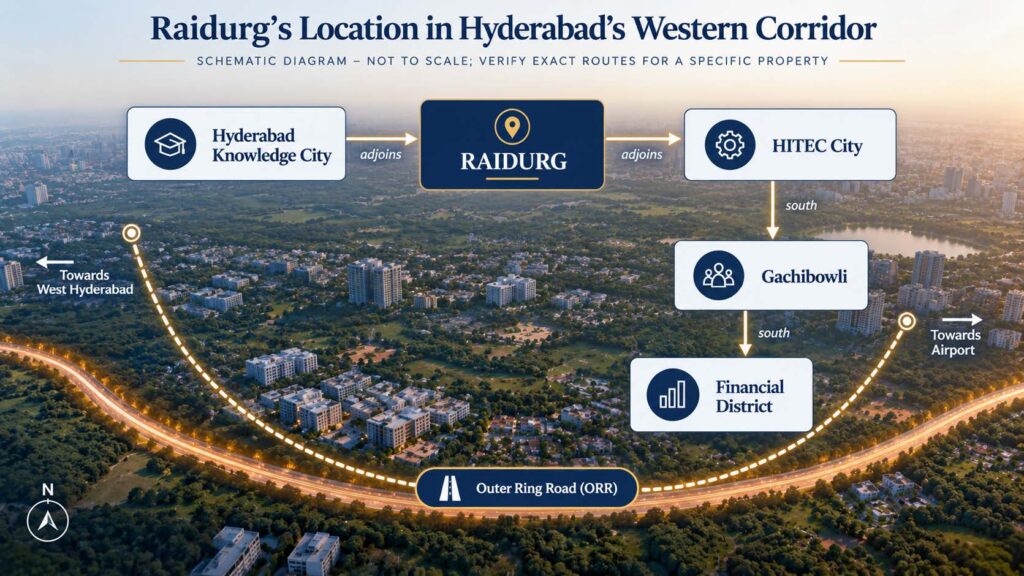
The migration from city centres to suburbs in India is no longer a pandemic-era anomaly. It is a structural shift, and Hyderabad is one of the cleanest case studies. The Outer Ring Road has redrawn the residential map, hybrid work has compressed the cost of distance, and a new generation of buyers is choosing larger homes in master-planned suburbs over compressed apartments in central locations. The numbers back this up: peripheral micro-markets in Hyderabad have outpaced central absorption for three consecutive years.
Here is what is actually driving the suburban move and what it means for buyers right now.
1. Hybrid work made the commute math optional
When you go to the office five days a week, every kilometre between home and work is a real cost. When you go in two or three days, that cost halves overnight. Suburban locations 8 to 15 km outside Hyderabad’s IT corridor that were unattractive in 2019 are now compelling because the daily friction has fallen away. The same buyer can afford a 1,800 sq ft 3BHK in Tellapur for what a 1,200 sq ft 2BHK costs in Gachibowli.
2. Bigger homes for the same budget
Pure rupee-per-square-foot is the cleanest comparison. Central Hyderabad micro-markets like Gachibowli, Madhapur, and Jubilee Hills sit at significantly higher per-square-foot rates than well-connected suburbs along the ORR. A buyer with a fixed budget moving from Madhapur to Kondapur, Tellapur, or Bachupally typically gains 30 to 50 percent more carpet area, plus a balcony, plus better amenities. That is the trade buyers are making.
3. Master-planned communities replace haphazard development
The early 2000s suburban experience in Indian cities was patchy: isolated projects, weak infrastructure, no schools, no retail. The 2020s version is fundamentally different. Integrated townships and gated developments now offer schools, clinics, retail, parks, and clubhouses inside the campus. Sansa County in Hyderabad is a clear example: residents do not need to leave the township for daily life, which removes the historic suburb objection of “everything is far”.
4. Infrastructure has caught up
Hyderabad’s infrastructure investment over the past decade has done the heavy lifting. The ORR cuts cross-city travel time meaningfully, the metro has extended into former edge locations, and the airport corridor has rewritten what “far” means. Kondapur to HITEC City is now an eight-minute drive on a clean afternoon. Tellapur to Financial District is twelve. Suburbs that used to feel disconnected are now within the daily-life radius of the central business districts.
5. Quality of life is the silent driver
The decision to move to a suburb is rarely about money alone. It is about the morning walk that exists, the open sky from the balcony, the noise level at night, the air quality, and the children playing outdoors without supervision. These are difficult to put on a spreadsheet, but they are the reasons families who move out rarely move back.
6. Stronger appreciation potential
Central micro-markets are largely built out. Their appreciation curves flatten because there is no scope for new infrastructure to change the area. Peripheral micro-markets are still maturing. As metro lines extend, schools open, and retail clusters form, prices step up in waves. The buyer who entered Kondapur in 2018 is sitting on meaningful capital appreciation today, and the same pattern is playing out in Tellapur, Kollur, and the Patancheru belt now.
7. Rental dynamics favour suburbs differently
Central locations still rent faster, but at lower yields relative to capital values. Suburbs deliver better rental yields and a different tenant profile: hybrid families and longer-stay tenants rather than transient single professionals. For investors holding for cash flow, the suburban math has improved noticeably.
8. The risks worth naming
Not every suburb is the right move. Buyers should still check four things: proven developer track record in that micro-market, current and committed road and metro infrastructure, social infrastructure within a 3 km radius, and whether the local sub-market has enough completed projects for resale liquidity. A suburb with five projects and one developer is fragile. A suburb with thirty projects and ten developers is robust.
Where Hyderabad’s suburban story is right now
The strongest suburban corridors in Hyderabad today are Kondapur, Tellapur, Kollur, the Patancheru belt, and emerging pockets along the airport road. Each has a slightly different character: Kondapur is the most mature, Tellapur is the cleanest greenfield, and Patancheru is still early in its appreciation curve. Buyers should match the suburb to their actual life rather than buying the headline.
Why are people moving from city centres to suburbs in India?
Three structural reasons: hybrid work has cut the cost of commute distance, suburban projects now offer 30 to 50 percent more carpet area for the same budget, and master-planned townships have closed the historic gap on schools, retail, and amenities.
Are suburban homes a good investment in Hyderabad?
Yes, particularly in maturing corridors. Central Hyderabad has limited new infrastructure scope, while suburbs along the ORR continue to see metro extensions, road upgrades, and social infrastructure additions that drive price step-ups in waves.
Which Hyderabad suburbs are seeing the strongest demand?
Kondapur is the most mature, Tellapur and Kollur are the cleanest greenfield options with strong developer presence, and the Patancheru belt is earlier in its appreciation curve. The airport road corridor is the next pocket worth tracking.
How do I evaluate a suburban location before buying?
Check four things: developer track record specifically in that micro-market, current and committed road or metro infrastructure, social infrastructure within a 3 km radius, and whether enough completed projects exist locally to support resale liquidity.