Hyderabad architecture tells the story of a 400-year-old city that has carried its identity through every era it has lived through. From the Qutb Shahi domes that defined the skyline in the sixteenth century, to the colonial-era civic buildings that arrived with the British, to the glass-and-steel office towers of HITEC City today, the city’s built environment is a layered record of who has lived here and what they cared about. For a developer working in Hyderabad, that history is more than nostalgia; it shapes how new buildings sit in the city and what residents expect from a great address.
This guide walks through the major phases of Hyderabad’s architectural story, the landmarks that anchor each era, and how the city’s modern developments are continuing that conversation today.
The Qutb Shahi Era and the Birth of a Hyderabadi Style
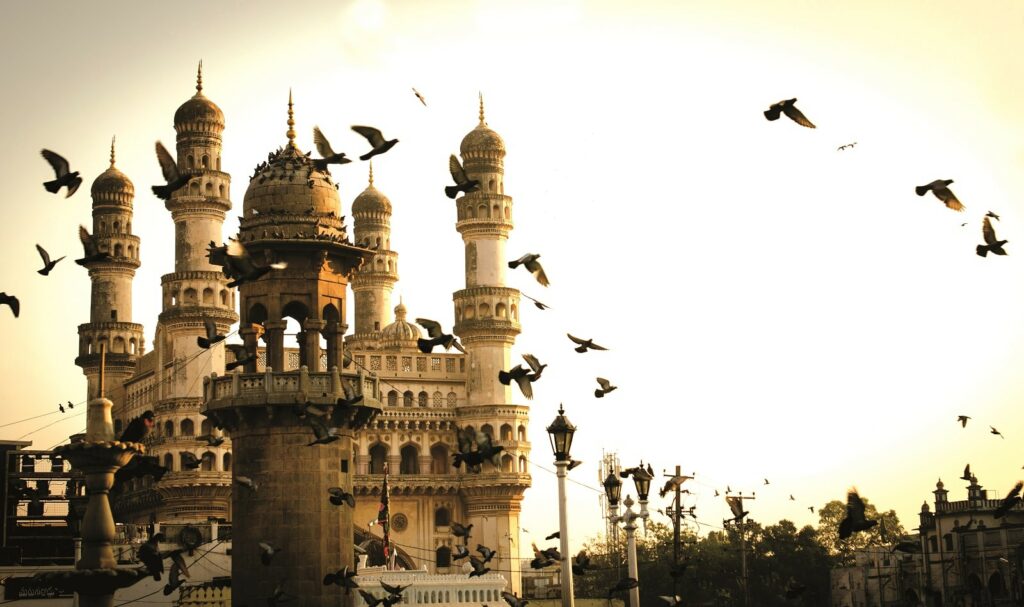
The architectural identity of Hyderabad begins with the Qutb Shahi dynasty, who ruled the Deccan from the early sixteenth to the late seventeenth century. The most recognisable expression of this period is the Charminar, built in 1591 with plaster and granite, anchored by four 56-metre minarets and a 36-foot triumphal arch on each side. The structure remains the symbolic centre of the old city.
A short distance away, the Golconda Fort sits on a granite hill that was the seat of the Qutb Shahi kingdom and a centre of the global diamond trade in its era. Its acoustic system, water supply network, and concentric fortification walls are still studied today as feats of medieval engineering. The same Qutb Shahi style runs through the Qila-e-Kohna and the Mecca Masjid, giving the era a coherent visual signature: pointed arches, lime plaster ornament, and proportions inspired by Persian and Indo-Islamic architecture.
Mosques, Temples, and a City of Many Faiths
Hyderabad’s religious architecture is one of the clearest signs of its layered cultural history. Within the old city you find the Jama Masjid, Mecca Masjid, and Kali Masjid, alongside dargahs like Mir Mahmud and Shah Raju. Across the river, Birla Mandir crowns Naubat Pahad in white marble, while Sitaram Bagh Temple, the Parsi Fire Temple, St. Mary’s Cathedral, and St. John’s Church each anchor their own community. The diversity of worship buildings, all within a few kilometres of each other, is a direct architectural reflection of Hyderabad’s pluralism.
Bridges, Gates, and Clock Towers
The Musi river runs through the city and is crossed by a series of historic bridges, including Purana Pul, Naya Pul, Chaderghat Bridge, Lakdi-ka-Pul, and Muslim Jung Pul. Each was built to connect the walled city to the newer northern districts and remains in daily use today.
The walled city was once entered through a sequence of grand gates: Purana Pul Darwaza, Dabirpura Darwaza, Delhi Darwaza, Afzal Darwaza, and Chaderghat Darwaza. Several of these have been lost to expansion, but the surviving structures still mark the historic boundary of old Hyderabad. Above them rise the city’s clock towers, including Mahbub Chowk, James Street, and Secunderabad, each a small landmark in its own neighbourhood.
Tombs and Civic Architecture of the Asaf Jahi Era
Under the Asaf Jahi Nizams, Hyderabad gained an elegant series of royal and noble tombs, including the Qutb Shahi Royal Tombs complex, Daira-e-Mir Momin, the Tomb of Amin al-Mulk, and the Tomb of Michel Raymond, the French general buried in the city he served. Built with durable materials and set within walled gardens, these tombs are a quieter side of Hyderabad’s architectural heritage.
From the nineteenth century onwards, civic architecture took centre stage. Banks, post offices, railway stations, public halls, law courts, and museums began appearing across the city, including Shamshir Kotha, the Khazana Building, Secunderabad Arsenal, the State Bank of Hyderabad, and the High Court on the banks of the Musi. The High Court, built in pink granite and deep red sandstone, remains one of the finest examples of Indo-Saracenic architecture in India.
Education, Commerce, and the Twentieth Century
Osmania University, founded in 1918 and re-housed in its iconic Indo-Saracenic main building in 1939, set the architectural template for many of Hyderabad’s later educational institutions, including St. George’s, the Nizamia Observatory, City College, and the State Central Library. These buildings used domes, arches, and local stone to give modern functions a distinctly Hyderabadi face.
Commercial Hyderabad grew alongside, with establishments like Lad Bazaar, the Nizam Club, the Lady Hydari Club, and Pathargatti Bazaar shaping the city’s everyday rhythms. Many of these survive in active use, with their original facades intact.
Contemporary Hyderabad: HITEC City and the New Skyline
The most recent chapter of Hyderabad’s architectural story begins with the formation of HITEC City and the broader Cyberabad cluster in Madhapur, Gachibowli, Kondapur, Manikonda, and Nanakramguda. The city today hosts global occupiers including Microsoft, Google, Amazon, Oracle, Accenture, and Deloitte, and the buildings that house them are designed to international Grade-A specifications, often with LEED certification and integrated workplace amenities.
This is the era our own buildings sit within. Auro Realty’s Galaxy, a 25-storey precast office tower in HITEC City, and our other commercial and residential projects are part of how the modern Hyderabad skyline is being shaped. The aim across our portfolio is to add buildings the city is proud of in a hundred years, the same way it is still proud of the Charminar four centuries on. To learn more about our approach to design and craftsmanship, read about Auro Realty.
Change has always been the constant in Hyderabad. From the Qutb Shahi domes to the glass towers of Cyberabad, what has stayed consistent is the city’s ability to adapt without losing its character. That continuity is what makes Hyderabad architecture worth studying for anyone evaluating the city as a place to live, work, or invest.
Official Resources & References: For verified information, visit RERA Telangana, NASSCOM.
What makes Hyderabad architecture unique?
Hyderabad architecture blends Qutb Shahi, Mughal, and Kakatiya influences creating a distinctive Indo-Islamic style. Iconic structures like Charminar, Golconda Fort, and Falaknuma Palace showcase intricate stucco work, grand arches, ornate minarets, and Persian-inspired gardens that reflect the city rich cultural heritage spanning over 400 years.
Which are the most famous architectural landmarks in Hyderabad?
The most iconic landmarks include Charminar built in 1591, Golconda Fort with its acoustic engineering, Falaknuma Palace now a luxury hotel, Mecca Masjid one of the largest mosques in India, Chowmahalla Palace the former seat of the Nizams, and the modern Hitech City skyline representing contemporary architectural growth.
How has modern architecture evolved in Hyderabad?
Modern Hyderabad architecture has evolved from traditional Indo-Islamic styles to contemporary glass and steel structures in the IT corridor. Green building practices, sustainable design, and smart building technology now define new developments. Many modern projects incorporate traditional Deccan design elements creating a fusion of heritage and innovation.