Patancheru’s residential market is evolving alongside Hyderabad’s expansion towards its western and north-western corridors. Established industrial employment, Outer Ring Road connectivity, new residential townships and proposed infrastructure have increased buyer and developer interest in the area.
But a 2030 property outlook should distinguish between infrastructure that exists today and projects that are still planned or proposed. Rather than predicting a guaranteed appreciation percentage, this guide examines the factors that could influence Patancheru real estate through 2030 — and the risks buyers should consider before making a long-term property decision.
Patancheru Real Estate Outlook to 2030 — At a Glance
| Factor | Current assessment |
|---|---|
| ORR connectivity | Existing |
| Industrial / employment base | Existing |
| Large residential developments | Existing / expanding |
| Metro connectivity | Approved, not yet operational — verify current status with HMRL before relying on it |
| Regional Ring Road impact | Dependent on implementation and final alignment |
| Residential demand | Project and micro-location dependent |
| Property appreciation | Not guaranteed; depends on market conditions and infrastructure execution |
For current location, connectivity, residential infrastructure and living considerations, see our Patancheru Hyderabad Guide.
What Could Drive Patancheru Real Estate Through 2030?
1. Existing ORR and Road Connectivity
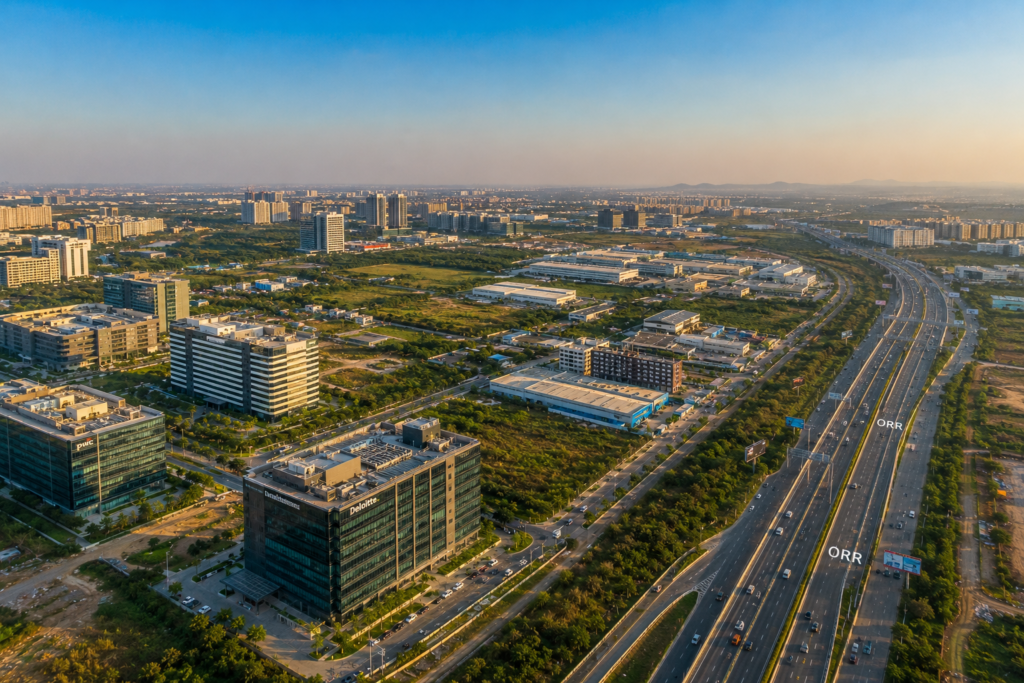
The Outer Ring Road provides an established road connection from the Patancheru corridor towards western Hyderabad employment districts, including the wider Gachibowli and HITEC City areas, and has done so since the Exit 3 extension completed in 2012. This is existing infrastructure, not a future promise.
2. Employment and Industrial Ecosystem
Patancheru has a genuine, decades-long industrial and pharmaceutical manufacturing base, which continues to support local employment demand for housing independent of any single infrastructure project.
3. Expansion of Residential Supply
Integrated townships, villas, apartments and plotted developments have expanded steadily in Patancheru over the past several years, giving buyers more format choice than the area offered a decade ago.
4. Hyderabad’s Westward Residential Expansion
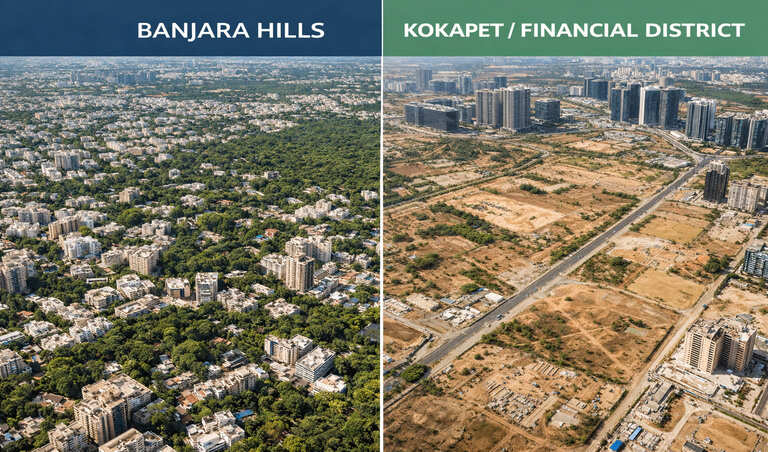
Hyderabad’s residential growth has been pushing towards its western and north-western corridors as more established markets fill up. This is a genuine citywide pattern — but it doesn’t mean every western suburb appreciates automatically, and Patancheru’s specific trajectory depends on its own infrastructure and supply dynamics.
5. Future Transport Infrastructure
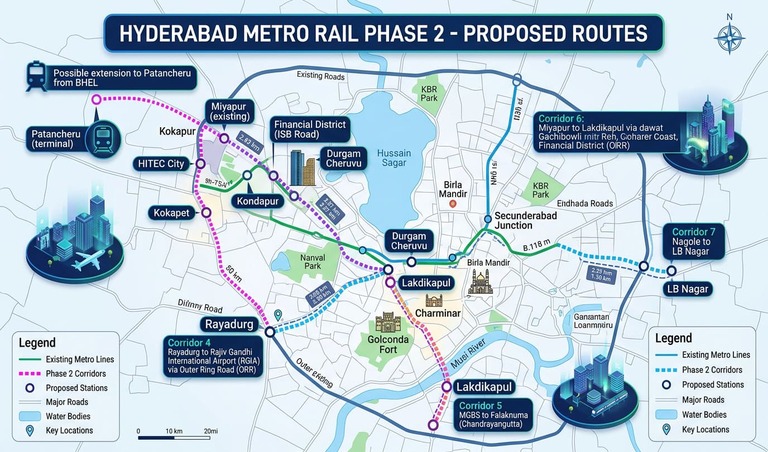
The proposed Miyapur–Patancheru extension forms part of Hyderabad Metro Phase 2 planning. Buyers should verify its latest approval, construction and commissioning status through official HMRL/government updates. The Regional Ring Road is a separate, broader project still subject to implementation timelines. Infrastructure announcements should not be treated as guaranteed property-value catalysts — buyers should check current implementation status and exact project proximity before factoring either into a decision.
Existing Infrastructure vs Proposed Infrastructure
| Existing today | Proposed / in progress |
|---|---|
| Outer Ring Road (Exit 3, completed 2012) | Miyapur-Patancheru metro extension (approved, not yet operational — verify status with HMRL) |
| Industrial and pharmaceutical employment base | Regional Ring Road (implementation and alignment ongoing) |
| Sansa County, Auroland and other residential developments | Further township and infrastructure announcements as they are confirmed |
This distinction matters for a 2030 outlook: existing infrastructure is a fact you can rely on today, while proposed infrastructure is a factor to monitor, not a certainty to price in.
What Makes Patancheru Relevant to Long-Term Property Buyers?
- Relative entry pricing: Patancheru generally offers lower entry prices than established western corridors such as Gachibowli or Kondapur, though this should be verified project by project rather than assumed.
- Housing formats: villas, apartments and plotted developments within integrated townships give buyers more choice than a single-format market.
- Employment access: genuine industrial and growing IT-adjacent employment in and around the area.
- Township-scale development: large integrated projects bring planned amenities rather than piecemeal construction.
- Road connectivity: existing ORR access rather than a connectivity story that depends entirely on future projects.
- Longer holding periods: Patancheru fits a longer-term ownership thesis better than a short-term flip, given how much of its growth case depends on infrastructure that is still being built out.
None of this guarantees a specific return. It describes why the area is relevant to evaluate, not a promise of outcome.
Risks and Considerations Before Investing in Patancheru
- Infrastructure execution risk: proposed infrastructure such as the metro extension and Regional Ring Road can be delayed, rerouted or altered before completion.
- Micro-location differences: “Patancheru” covers a mix of residential and industrial contexts; a project a few kilometres away can have a meaningfully different profile.
- Environmental history: Patancheru has a documented industrial legacy and past environmental concerns around water quality. Project-level due diligence on the specific site and its surroundings matters more than the area’s reputation as a whole.
- Supply risk: a large volume of upcoming residential supply across multiple townships could affect pricing and rental yields if demand doesn’t keep pace.
- Developer and project risk: check RERA registration, approval status, construction progress and the developer’s delivery history for any specific project, in Patancheru or anywhere else.
- Holding period: this is an emerging corridor whose growth case depends partly on infrastructure still being built. It should be evaluated as a longer-term decision, not a short-term guaranteed return.
Patancheru vs Established Western Hyderabad Markets
| Patancheru | Established western markets (e.g. Gachibowli, Kondapur) |
|---|---|
| Emerging residential development | More mature, established residential ecosystem |
| Potentially different entry pricing | Generally higher established-market pricing |
| Larger township opportunities | More developed social infrastructure |
| Future infrastructure can matter more to the outcome | Existing connectivity already carries most of the weight |
| Longer-term growth thesis | More established, better-documented demand patterns |
There isn’t a single right answer here — it depends on your timeline, budget and how much infrastructure-execution risk you’re comfortable holding.
Auro Realty Projects in Patancheru
Patancheru’s residential development trend — larger integrated townships, a mix of villas and apartments, and plotted developments — is broader than any single developer. Auro Realty’s projects in the area are examples of that trend, not the reason for it:
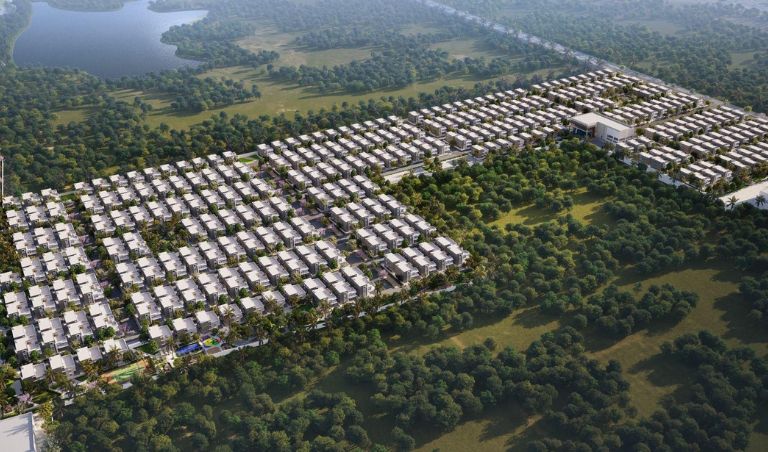
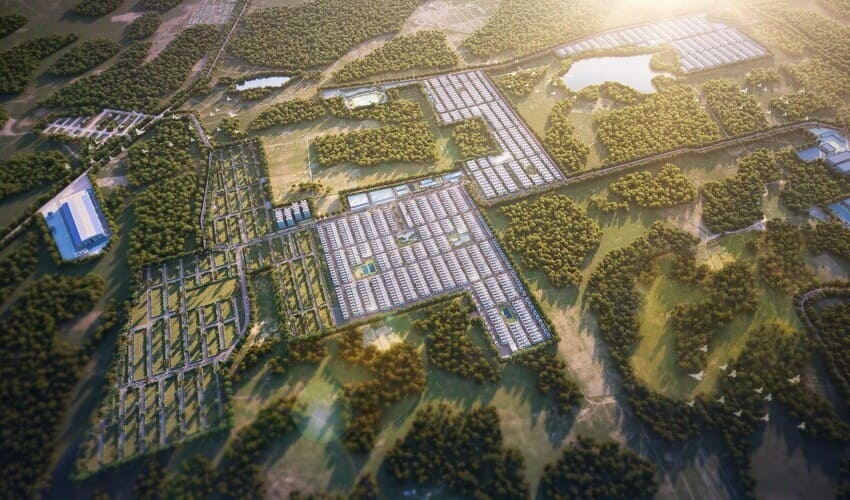
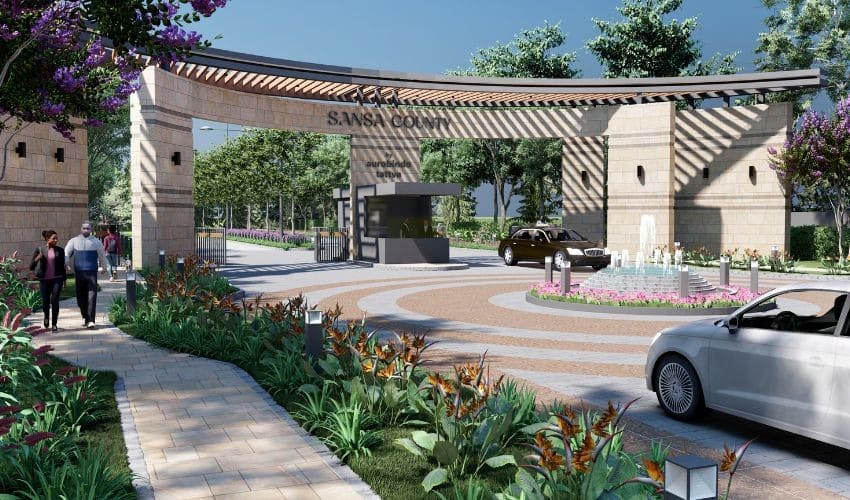
- Sansa County: a 313-acre integrated township offering 4 BHK triplex villas, built around lakes, parks and shared amenities.
- The Apartments at Sansa County: apartment-format homes within the same township for buyers who prefer that format over a villa.
- Auroland: plotted development for buyers who want to build to their own timeline and design.
Related Reading
- Patancheru Hyderabad Guide: Location, Connectivity & Real Estate
- Patancheru Property Legal Checklist
- Hyderabad 2030 Vision
- 5 Reasons Behind Hyderabad’s Real Estate Growth
Conclusion: Patancheru’s 2030 outlook rests on real, checkable factors — existing ORR connectivity, a genuine employment base, and expanding residential supply — alongside proposed infrastructure that is not yet built. Treat the existing factors as facts and the proposed ones as things to monitor, not guarantees, and weigh the risks above against your own timeline before deciding whether Patancheru fits your plans.
Last reviewed and updated: August 2026.
Frequently Asked Questions
Is Patancheru a good area for long-term property investment?
Patancheru suits a longer-term view better than a short-term one. It has existing ORR connectivity and a genuine employment base, plus proposed infrastructure like the metro extension that is approved but not yet built. Buyers should weigh these real growth drivers against project-level, developer and micro-location risk rather than expecting guaranteed appreciation.
What could drive Patancheru real estate growth through 2030?
Five factors matter most: existing ORR and road connectivity, the area’s industrial and employment base, expanding residential supply across townships and apartments, Hyderabad’s broader westward residential growth, and future transport infrastructure such as the approved metro extension, once it is actually built.
How does ORR connectivity affect Patancheru?
Patancheru is served by ORR Exit 3, with the extension to the area completed in 2012. This gives existing road access to Miyapur, Kondapur, Kukatpally and, via NH 65, towards Pune and Mumbai — connectivity that already exists today rather than depending on a future project.
What is the current status of proposed metro connectivity to Patancheru?
A Miyapur-Patancheru metro extension (Corridor VII of Hyderabad Metro Phase 2) has state cabinet approval, with central government clearance in progress. It is approved but not yet operational — buyers should verify its latest approval, construction and commissioning status through official HMRL/government updates rather than assume it exists or rely on any specific timeline.
What types of property are available in Patancheru?
Patancheru offers plotted developments, villas, gated-community apartments and large integrated townships, catering to different budgets and formats. This range has expanded meaningfully over the past several years as more developers have entered the area.
What risks should investors consider in Patancheru?
Key risks include infrastructure execution delays on proposed projects, meaningful differences between micro-locations within Patancheru, the area’s industrial and environmental history, the volume of upcoming residential supply, and standard developer and project risk such as RERA status and delivery track record.
How is Patancheru different from established western Hyderabad locations?
Compared to established markets like Gachibowli or Kondapur, Patancheru has a less mature residential ecosystem and generally different entry pricing, with larger township opportunities but less developed social infrastructure. Its growth case depends more on future infrastructure execution, while established markets rely more on connectivity that already exists.