The Hyderabad Metro Rail story has shifted from a single-corridor network to a citywide expansion programme, and that shift is showing up directly in property prices. The Phase 2 plan adds roughly 76 km across five new corridors, connecting the airport, the western IT belt, and the eastern industrial spine. For homebuyers and investors, the question is no longer “will the metro come to my area” but “what does the new alignment do to my project’s pricing and resale liquidity”.
This post breaks down what is being built, where the price impact has been strongest, and how to read upcoming corridors before they get priced in.
What Is in Hyderabad Metro Phase 2
Hyderabad Metro Phase 1 (the existing 69 km Red, Blue and Green lines) has been operational since 2017-19. Phase 2, sanctioned by the Telangana and Union governments and currently under detailed project work, adds five major corridors:
- Nagole to Shamshabad Airport (~37 km) — east-west spine that finally connects the city to RGIA and crosses the Outer Ring Road.
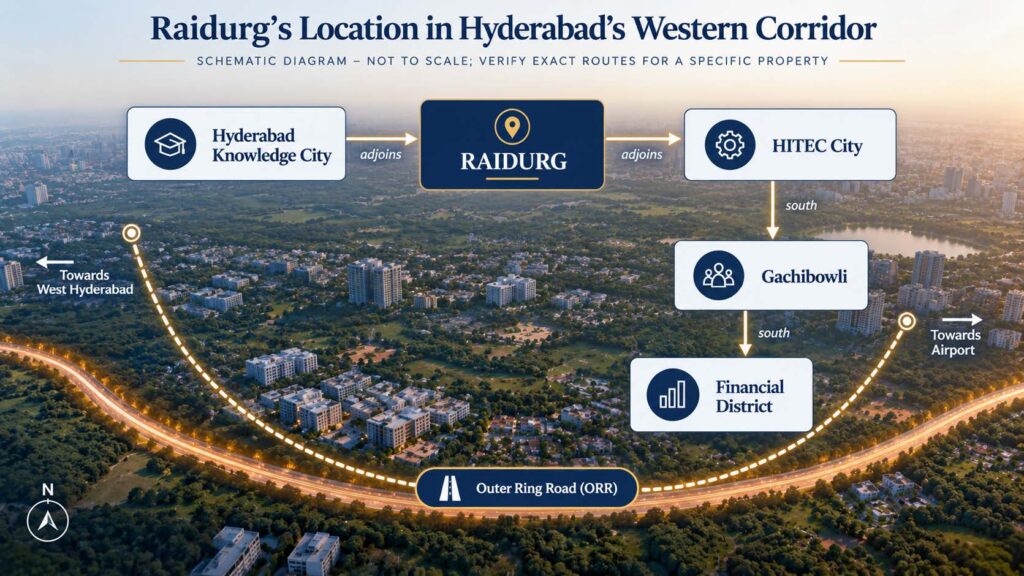
- Raidurg to Kokapet (~12 km) — extends the Blue Line into the Financial District and the new ORR-flank growth zone.
- MGBS to Chandrayangutta (~7-8 km) — completes the south Hyderabad loop.
- Miyapur to Patancheru (~13 km) — pushes the Red Line into the BHEL belt.
- LB Nagar to Hayathnagar (~7 km) — east-side expansion towards Vijayawada highway.
Construction timelines vary corridor to corridor, with the airport line and the Kokapet extension usually cited as the highest-priority phases.
How Metro Proximity Affects Property Prices
The pattern observed in the Phase 1 corridors is now well documented. Prices in micro-markets within roughly 1 km walking distance of an operational metro station typically command a 15-25% premium over comparable non-metro stock in the same suburb. The premium is highest in the first two years after a station opens, and it tends to compress as new supply gets built around the station and the catchment matures.
Rental yields on metro-adjacent stock have also held up better than the city average — a 0.3-0.6 percentage-point cushion in most corridors — because tenants from the IT belt actively filter for metro access.
Corridors to Watch in Hyderabad Right Now
For buyers thinking about the next two to four years, three corridors deserve close attention:
- The airport line through Mailardevpally and Aramghar — a long-undervalued stretch that will get repriced once construction physically begins. Land deals in the catchment have already started moving.
- Raidurg to Kokapet — overlaps with the most expensive new luxury supply in West Hyderabad. Effect here is less about price discovery and more about absorbing larger inventories at current rates.
- Miyapur to Patancheru — shifts demand westward from saturated Kondapur/Madhapur micro-markets and improves connectivity for the BHEL/Sangareddy belt.
What Buyers Should Verify Before Paying a Metro Premium
- Confirm the station location on the official HMR sanctioned alignment, not on a brochure illustration. Alignments shift during DPR finalisation.
- Walk the actual route from the proposed station to the project gate — “1 km from metro” can mean a 25-minute walk on broken footpaths in some pockets.
- Cross-check construction status with HMRL and L&T Metro Rail public updates rather than relying on builder timelines.
- For under-construction projects priced at a metro premium, factor in the possibility that the corridor finishes 2-3 years late — that delay typically holds back resale appreciation.
What This Means for Long-Term Investors
Hyderabad’s metro expansion is one of the few infrastructure programmes in India where the political consensus, the central funding and the engineering execution are all aligned. For long-horizon property investors, the framework is straightforward: identify projects on or near sanctioned Phase 2 corridors that are still pricing closer to their non-metro peers, and let the corridor execution close that gap over the next cycle.
For broader market context, see why buying an apartment in Hyderabad remains a smart decision and our breakdown of the luxury housing surge thesis for 2026.
Related Reading
- 5 airports in Telangana and how connectivity drives RE
- 5 reasons behind the growth of Hyderabad real estate
- What sets Hyderabad apart from other Indian cities
- Benefits of living close to your work location
- Property registration process in Telangana
How does metro rail expansion benefit Hyderabad’s real estate market?
Metro expansion improves accessibility, reduces commute times, increases property values near stations by 10-20%, attracts commercial development along corridors, and opens up previously undervalued areas for residential growth.
Which upcoming metro routes will impact Hyderabad real estate the most?
The planned extensions to the airport, Old City, Shamshabad, and western suburbs will significantly boost property values along these corridors. Areas near proposed stations that currently have lower prices offer the best investment timing.
How much does metro proximity affect property prices in Hyderabad?
Properties within 500 meters of operational metro stations see 15-25% price premiums. Even areas within 1-2 km benefit with 8-12% higher values. The impact is most pronounced for mid-segment properties targeting commuting professionals.